|
British colonies and tax evasion
By David Eade
As you read this the G8 Summit will be in its second day in Northern
Ireland. The fact that tax evasion will be firmly on the agenda and
that at least one British territory is cutting up rough over having
to sign the OCDE convention is like manna from heaven for such
Spanish newspapers as ABC.
The territory is question might be Bermuda and not Gibraltar but
fear not Madrid will find a way of making a link.
David Cameron has made a great play of putting tax evasion at the
top of the agenda and it is a key issue which will be addressed by
G8 leaders including Presidents Barack Obama and Valdimir Putin.
Indeed our own Chief Minister was invited to London by Cameron for
the weekend first to see the Trooping of the Colour and then for a
private chinwag ahead of the G8 Summit. Without a doubt the fight
against tax evasion was the sole agenda item.
ABC trumpets the fact that Oxfam estimates of the funds that evade
tax in the EU half is stashed away in British territories. It then
goes on to name technology giants such as Google, Apple and Amazon
who have hit the headlines for tax avoidance yet none of which
happen to have any link to Gibraltar what-so-ever. With Bermuda they
made do which is probably why that government is resisting overtures
to sign from Cameron.
The Spanish daily states that only Jersey and Guernsey and the Isle
of Man have so far voluntarily signed the convention on financial
transparency and interchange of information of the OCDE. This it
states has been signed by 55 countries and is considered to be one
of the most efficient tools to prevent fiscal evasion.
It pointedly states that Gibraltar has not signed this convention so
by implication we are resisting or refusing to do so. However that
is far from the case. The Chief Minister recently wrote to David
Cameron requesting that the OECD and Council of Europe Convention on
Mutual Administrative Assistance in Tax Matters be extended to
Gibraltar. In other words it is the UK and not us who must act.
Fabian Picardo went on to explain that such an extension forms an
integral part of the our Government’s continuing policy of having
Gibraltar recognised as being at the very forefront of jurisdictions
seeking to eradicate tax evasion. The Chief Minister also pointed
out that Gibraltar has already implemented the EU Directive
concerning the exchange of information on tax matters and has
entered into Tax Information Exchange Agreements with 26 countries.
He also stressed that Gibraltar complies with the EU Savings
Directive on automatic exchange of information and that Gibraltar is
fully up-to-date with all its EU transposition obligations.
The Chief Minister added he believes that Cameron recognises that
‘Gibraltar is the benchmark jurisdiction in many respects in the
field of the regulation of financial services. Well let us hope he
does and is busy telling the G8 just that.
It is ironic to note that ABC also takes Barack Obama to task for
allowing the State of Delaware to operate an off-shore financial
territory firmly on USA soil. There the registry of companies, it
says, is totally opaque basis. What ABC fails to state is that many
of the companies registered there and in other dubious off-shore
territories on that side of the Atlantic are major Spanish owned
companies. These Spanish household names avoid paying tax in Spain
and yet the government in Madrid, although losing millions of euros
in taxes as a result, has done nothing to curb there activities.
Sadly for ABC that truth is not such a good story as a bit of Brit
bashing.
Frontier queue situation on the La Linea side
By David Eade
Life is full of coincidences. Last Friday I wrote here that it was
time for the mayor of La Línea, Gemma Araujo, to stop the talking
and do something about the border queue situation. Later that day
she met our Chief Minister. By Monday afternoon there was a Guardia
Civil patrol at the roundabout junction by the loop ordering
trafficking and ensuring cars did not cut in.
The Guardia Civil was there on Tuesday too and I hope today as well.
However my experience of these things is that we get a show of
authority for a day or two and then it is back to unorganised chaos.
One also has to question whether highly trained Guardia Civil
officers are the right people for the job when there are local
police in La Línea who could do it as effectively.
It is so far so good but much more needs to be done. True the
Guardia Civil have cut out the queue jumping at the roundabout
whilst they are there. The fact still remains that traffic has to be
better managed in that zone.
The first point is that some of the cars that cut across at the
roundabout are not coming on to Gibraltar but trying to get to that
section of La Línea's port. It is ridiculous they should have to
join the queue to get on to the Rock. However some people indicate
they want to go to the port and then once through queue jump.
The second point is that on land by the final stretch of the access
road is the Parking Solidario. This is a plot of land owned by the
Algeciras port authority which the jobless in La Línea have been
allowed to take over on a temporary basis to operate as a parking
lot. It usually fills up quickly with many workers on Gibraltar
parking their cars there every morning.
When it first started you could cross the traffic at the roundabout
- loop and drive straight in to the parking lot. Now you have to go
round the loop itself and then cut across the queuing traffic at the
entrance. Needless to say this is a far from ideal situation and
also allows for queue jumpers to pretend they are going to the
parking when they are not.
Those operating the Parking Solidario are also unhappy that under
the new regime with the Guardia Civil controlling drivers their
customers are not allowed to cut across at all but have to join the
Gibraltar queue. This is an inconvenience to them but also means the
Gibraltar queue is longer that it should be because it has car park
and port users amongst its number.
As I have said before the solution to the traffic queues cannot be a
quick fix. There has to be designated lanes for Gibraltar traffic
with easy access for car park and the port users. All this has to be
free from the ability to abuse the system and has to be policed. We
are far from that happy state as of yet but it's a start, it's a
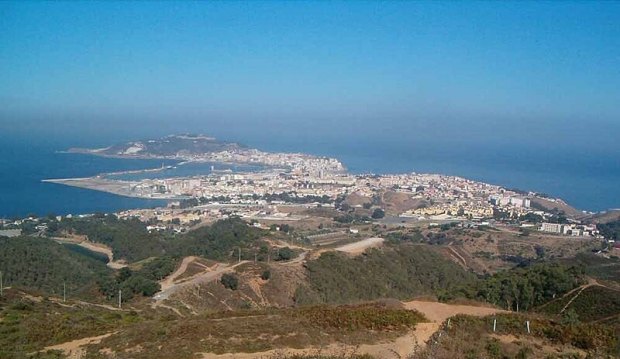
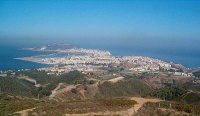
start. The Gibraltar, Ceuta, Melilla triangle: Why
Ceuta and Melilla might become Moroccan, but Gibraltar will never be
Spanish By David Eade
I had a sense of déjà vu when I read an interview with Angel Manuel
Ballesteros in which he put forward the view that if Spain recovered
in his words Gibraltar then Ceuta and Melilla could be handed over
to Morocco.
Ballesteros is a former diplomat, ambassador, academic, writer and
so on and so forth so his words are listened to in his native Spain.
His exact words were: "Las diferencias en el pretendido paralelismo
entre Gibraltar y Ceuta y Melilla son tan sustantivas que no sólo
desautorizan la supuesta identidad sino que permiten demostrar la
distinta entidad y, por ende, la independencia de los casos. Ahora
bien, igualmente existe un approach geostratégico de nivel: ninguna
potencia permitirá que España controle las dos orillas del Estrecho,
o dicho de otra manera, cuando España recupere Gibraltar, las
ciudades pasarán a Marruecos, que es el leitmotiv desde el vecino
del sur."
I stated this gave me a sense of déjà vu because as long ago as the
mid-1990s I wrote of a geopolitic that could well see a trade off
between the powers. Morocco, a valued ally of the West, would be
allowed to take possession of Ceuta and Melilla, which it claims for
its own, and in return Spain would be compensated with Gibraltar.
I suspect such an outcome would as Ballesteros suggests be
acceptable to Madrid. Even though it has made the two North African
enclaves parts of mainland Spain, and although leading Spanish
politicians and the Royal Family go there on high profile visits,
the pressure is very much on from Rabat return them. If Spain could
save face by getting Gibraltar in return then such a deal would be
snapped up tomorrow.
I did say I wrote my article in the mid-1990s and the world and
Gibraltar's status in it has changed a lot since then. What has not
changed is the Ballesteros and Partido Popular mindset that believes
a geopolitic deal with a change of sovereignty in the three
territories is a possibility. It isn't.
What has not changed is that Morocco still claims Ceuta and Melilla.
What has not changed is that Spain still claims Gibraltar. What has
changed is that the people of Gibraltar now have the right to self
determine their own future: a right that is openly recognised and
underscored by both the British Government and the British Crown.
From the days just over a decade ago when Blair and Aznar tried to
stitch a deal on Gibraltar together we are now in the situation that
Gibraltar's "independence" has never been more assured within the
British family. Gibraltarians also as a people have their right to
self determine their own future clearly set down in international
law.
Unfortunately for the people of Ceuta and Melilla they have no such
rights because they are Spanish citizens. Hence if Madrid decided
tomorrow to hand the enclaves over to Morocco they could either move
to mainland Spain or stay put but they would have no say on that
policy. So Ceuta and Melilla may well become Moroccan but Gibraltar
will never become Spanish. The Gibraltar MP debate
By David Eade
I am pleased that my article of last week on the UKIP MEP and leader
Nigel Farage's proposal that the British Overseas Territories should
have their own MP has generated a debate.
I also touched on whether Gibraltar should have a directly elected
MP or whether our Government was effective enough at Westminster
along with the All Party Gibraltar Group. I wrote that before the UK
Prime Minister David Cameron invited our Chief Minister Fabian
Picardo for talks ahead of the G8 Conference. This is the second
visit by Picardo to No.10 this year and it is a credit to Gibraltar
that we are now taken seriously in the corridors of power in London
and at the EU with our views being sought.
I think the BOT or Gibraltar MP needs to be looked at also in
comparison with the work done at Westminster by the All Party Group.
I have already stated that for an MP to cover the entire BOTs would
be an impossible task both physically but also because the interests
of one area may not be compatible with those of another. One of the
benefits of the All Party Group is that we have a team of MPs
dedicated to protecting Gibraltar's interests and voicing our
concerns in addition to our Government. It also means that whatever
party is in government in the UK we will have MPs on those benches
speaking for Gibraltar.
Now to Ken Westmoreland who has been sharing his views with me for
more years than either of us wish to remember. On this issue Ken
writes: "I read your article with interest, and actually wrote an
email to Nigel Farage criticising what he was suggesting, because it
did not take into account what each of the overseas territories
want.
Politicians in the Falklands have actually been more hostile to the
idea of representation at Westminster than Gibraltar have, while I
doubt seriously that Bermuda or the Caribbean territories would
favour it. While integration is something I would support, it is no
longer something I advocate, and even when I have advocated it, I
have regarded the issue of overseas territories' constitutional
arrangements as a red herring. Neither the French nor the Dutch have
a 'one size fits all' approach to their overseas territories.
"Farage mentioned the 'lesson' of Malta, but this was a totally
different situation - the Maltese government under Dom Mintoff
advocated integration and got the UK to agree to it, only for talks
to founder on the issue of finance. It is not surprising that
Whitehall has been unenthusiastic about the idea since.
"I, personally would like there to be overseas constituencies in the
UK Parliament irrespective of what future the overseas territories
may have; Italy, unlike France, no longer has overseas possessions,
but it has twelve deputies and six senators for its expats (not
'ex-pats' - while I have been an expatriate, I have never been an
'ex-patriot!) This may be an anomaly, but no more than the old
university constituencies, which gave some people an extra vote.
However, I think that constitutional reform is off the agenda for
the current UK for the foreseeable future, at least until the
Scottish independence referendum is held and the outcome is known."
Well you know my views and now you know Ken's. No doubt others will
add still to the debate. |
|